

Motorbike MOT testing Centre

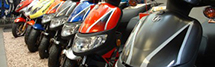
Scooter, Motorbike and used bike sales

About our Bike MOT testing

The MOT is effectively the examination of a motor vehicle's safety-related systems components to ensure that they have not worn to an excessive level which would otherwise render the vehicle unsafe for use on the road.

It is possible for items to pass the MOT inspection and yet still be regarded as past their service life at a routine service.

Fortunately garages which do have a current MOT Testing permit and the necessary specialised training will not judge normal wear of a component as being an MOT 'failure', whereas a less experienced servicing mechanic would not appreciate the distinction.

By utilising the services of an MOT Testing Centre you are likely to save time and money and reduce the risk of Appeals to the Vehicle Inspectorate where you car may have been failed on the wrong grounds.

If your vehicle fails an emissions test because of defective exhaust components, it may not be necessary to replace the complete exhaust system. Even a small leak in the exhaust can affect test readings so have the exhaust components checked before submitting your vehicle for its annual MOT Test.


LIGHTS

Of the 20% failure rate on bike MOT tests, over half are for defective lights. Quite amazing since these are amongst the simplest items to check yourself before going to the test.

The requirements are simple, and quite straightforward to replace or adjust, without the need of a mechanic.

Headlights & Tail lights must be free of chips or cracks; the headlight must also work on main and dip beam, the main beam must shine directly ahead and the dip slightly lower and to the left.

Indicator lights must all flash at a steady rate and the warning lights function properly.

If a hazard warning system is fitted, all 4 indicators must flash at a steady uniform rate.

Bikes must have a red reflector on the rear of the machine, either bolted on separately or as part of the tail light lens.

STEERING

The next highest fail rate is on steering, look at the test items below and if you’re in any doubt as to whether they will pass, consult a qualified service engineer.

  • With the front wheel raised off the ground the handlebar must not hit or foul the tank when the steering is fully turned lock to lock, the steering must move freely and without drag or notchiness.
  • The handlebar must be securely mounted and the grips secure.
  • With the fork sliders held, try to push and pull on the forks, there must be no play in the steering head bearings.

BRAKES

In day-to-day riding there is perhaps no more important part of your bikes equipment that, when working properly, may just save your life! It is also the third highest reason for failure in MOT testing.

The examiner will:

  • Check the hoses for fluid leaks, bulges & cracking
  • Check disc brakes are securely mounted and free from cracks
  • Check ABS warning lights, where fitted
  • Check the wheel is free to rotate without brake drag in free-wheel
  • Check that brake pads/shoes are not warn beyond limits
  • Check the rear brake torque arm is secure and that fasteners are secured by self-locking nuts or castellated nuts with split-pins or R-clips

WHEELS & TYRES

Over one quarter of MOT test failures are due to worn tyres, remember, safety first – worn tyres can kill! Here are the main items the examiner will check on the bike:

  • Cast wheels should be secure and free from cracks, similarly, spoked wheels will be checked for broken, corroded, loose or bent spokes
  • The tyre and wheel must run free in free-wheel nor must they fould the suspension or the mudguards
  • Worn wheel bearings will fail and the front and rear wheels will be checked for alignment
  • Tyres must be compatible, suitable for road use and, if fitted with a direction arrow, fitted to spin in the direction of forward wheel rotation
  • Tyres will be checked for tread depth and condition as well as sidewall condition.>

SUSPENSION

As the tests are subtly different we will deal front and rear separately. For the front suspension the examiner will check:

  • No oil leaks from anti-drive units
  • On bikes with swingarm suspension, there must be no freeplay in the linkage when moved from side to side
  • There should be no oil visible on the fork tube or leaking down the slider around the fork oil geras
  • The forks must be adequately dampened

At the rear, the checks will be:

  • No oil leaks around the shock absorber
  • No play in the swingarm or suspension linkage bearings
  • Pivot bearings will be checked for wear
  • The shock absorber must give adequate damping
  • The suspension must not foul on body parts or acessories

EXHAUST SYSTEM

The decibel level will be assessed at the discretion of the tester, other checks are:

  • The exhaust mountings must be secure and not fouling any part of the rear suspension
  • The exhaust must not be holed and free from leaks from both joints and box(es)
  • Replacement units, other than bikes registered before 01.Jan.1985, must have the BSAU 193 stamp

FINAL DRIVE

  • The chain/belt must not have excessive slack and be in good condition, the guard must be secure and not fouling
  • On shaft drive bikes, the drive unit must be free from oil leaks
  • Both sprockets should be securely mounted and not excessively worn

MORE CHECKS

In addition to the items mentioned above the examiner will:

  • Check that the HORN is of reasonable volume and a continuous single tone
  • Check for corrosion on the frame and any load bearing components
  • The Footrests must have an anti-slip surface
  • All major components, bodypanels and mudguards must be securely fitted
  • The footrests, handlebar levers and brake pedal must be securely mounted